Cameron McKay
 -
The jQuery animate() step callback function
Continue reading →If you've ever needed to do more complex animations than fades and slides, then you've probably encountered the jQuery
animatefunction. Theanimatefunction allows you quite a bit more flexibility than just usingfadeOutorslideDown. In fact, the oft-used fades and slides simply wrap calls toanimate.If you've ever looked at the jQuery
animatedocs at api.jquery.com you might have noticed that one of the optional arguments you can define isstepwhich is defined as:A function to be called after each step of the animation.
...and that's it. If you search for "step" on the page, you won't see another mention of it.
-
What I Liked About Final Fantasy
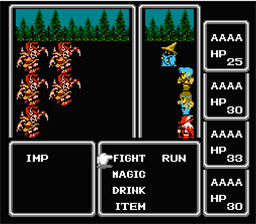
Continue reading →Final Fantasy, a.k.a. FF1, is an NES RPG first published in Japan in 1987 and then in North America 3 years later. I remember when I first played it as a kid at my friend Dave's house. It blew my mind. I would dream about Fighters and Red Mages and making the orbs shine again.
 Recently, FF1 was released on the Wii Virtual Console and, even though I already owned it on my NES, I felt the urge to play the classic again without the fear of my NES crashing because I blinked too hard.
So I flipped on my Wii, downloaded the game, and played it for about 2-3 hours a night for a week (keep in mind I logged many, many hours playing this game as a child). Here are my thoughts on the title.
-
Fep Section
Continue reading →I just added a new Fep section. I'm going to try to work on a bit more (just ordered this sucker) as making a programming language has been something I've always had an interest in.
First stop: parsers!
-
Inconsistencies in the .NET Enum class
Continue reading →During a recent project of mine, I had to do a lot of enum manipulation using the .NET Enum class and I have to say I wasn't impressed. Besides the shortcoming of it not being a generic class (and thus not being especially type-safe), Enum also has some strange inconsistencies in terms of how it handles matched integral types.
-
Wezzle Beta 1 Screenshots
Continue reading →Here are some Wezzle screenshots from the latest beta.

-
Fep Collections
Continue reading →As I was working on the PHP classes that Fep was to map to, I realized that it was rather silly for me to re-invent an API for lists since there were already many well-designed ones in existence. In particular, I've found that the .NET 3.5 collections API to be particularly nice to use. Moreover, since everyone and their dog and using .NET now, it would also be familiar to most programmers. Thus, I've decided to use a subset of the .NET collections API for Fep collections.
-
Fep Arrays
Continue reading →Disclaimer: This is not the way Fep arrays will work. Refer to the new article on Fep collections for more information.
In this article, I'll write a bit about how I think Fep arrays will look. Keep in mind this a work in progress and is by no means comprehensive. Without further ado...
In PHP, you define an array using the
array()construct. Fep will follow the lead of languages like JavaScript, Python, Ruby and Groovy and use the square bracket[]notation.Initialization
For example, a simple array in PHP is creating like this:
$arr = array(1, 2, 3);In Fep, this would be done like this:
arr = [1, 2, 3] -
Fep: A cleaner PHP
Continue reading →PHP bugs me. It's a language with so many inconsistencies, it's just screaming to be cleaned up. I'm surprised it hasn't happened yet. That's why I'm starting a series of articles on Fep, a cleaned up version of PHP.
-
Why your custom EnumStringType might not be working
Continue reading →I recently spent a couple hours yesterday to fix a problem I was having with my custom
EnumStringType(see this post).Basically, what was happening was when my repository was making a call to
ICriteria<FooType>.List(), which in turn called theSetmethod ofEnumStringType, it was always passing in a lowercase string instead of an enum instance. -
How to put spaces in your NHibernate enums
Continue reading →NHibernate lets you map C# enums to database columns. This can be quite convenient in cases where you have a database column for something like gender. To map them, you follow the procedure outlined here.
That works all fine and dandy, as long as the strings you want to store in the database are valid C# identifiers.